
Edgewood Criminal History Checks
Edgewood sits in both Delaware and Clayton Counties. The exact incident location and responding agency are the keys to a useful Edgewood record check. City Hall can help identify a local custodian, while the jail and clerk depend on the county that handled custody and filing. A county-only search can miss the other side of Edgewood.
- Pin down the Edgewood street address, date, and responding agency before making a request.
- Contact Edgewood City Hall when the correct city or law-enforcement custodian is not clear.
- Search Iowa Courts Online statewide, then test Delaware and Clayton county filters as needed.
- Check the jail or booking office for the county that received the arrest; do not stop after one roster.
- Use the Iowa DCI name check for releasable statewide history or the FBI subject-only process for your own federal identity history.
Compare middle names, dates, county, and other lawful identifiers. An Edgewood name match is a lead to verify, not proof of identity or guilt.
Edgewood Spans Two Counties
Edgewood’s shared-county identity is not trivia. It controls where a report, booking, and court case may be found. A Delaware-side incident may involve Delaware County channels, while a Clayton-side event may use a different sheriff, jail, and clerk. Even within one city, the Edgewood record trail can split after the first call.
Start with location. If that is unknown, search Iowa Courts Online statewide and repeat with both county filters. Ask which agency responded and which facility received custody. This boundary-first method is more accurate than forcing all Edgewood criminal records into the Delaware County system.
A postal address that says Edgewood is not enough to select a county record office. Use the Edgewood incident street, agency name, citation, booking paper, or case number. If an Edgewood record request reaches the wrong office, ask which custodian is likely to hold the file and redirect the request. Preserve the reply because it documents the route already checked.
Records at the Edgewood Police Department
No verified Edgewood police records portal, online report-copy form, arrest blotter, municipal docket, or official records app was located. Do not invent a digital route. Edgewood City Hall is the practical first contact for identifying the correct local custodian. Emergencies still use 911, but that number is not a records line.
A focused inquiry should include requester contact information, the existing record sought, date range, incident location, responding agency if known, and desired format. Those details help City Hall route the Edgewood request without asking Edgewood to create a new report or conduct open-ended research.
Edgewood Records Start at City Hall
Edgewood City Hall operates inside Edgewood Public Library at 203 West Union, P.O. Box 397, Edgewood, IA 52042. The phone is 563-928-6842, fax 563-928-6962, and city email is edgecity@iowatelecom.net. Published weekday hours are 8 a.m. to 4 p.m. This unusual library setting is Edgewood’s public counter for a records inquiry when the custodian is uncertain.
The official Edgewood government page supplied the City Hall image.

The image grounds the Edgewood request route in the correct public building and confirms why the library address appears in city contact information.
City Hall can route an inquiry, but it should not be asked to produce a sheriff’s booking or a district-court judgment that it does not hold. Describe the Edgewood record by event and date. Staff can then identify whether an existing city record is responsive or whether a county law-enforcement or court office is the better source.
Booking and Arrest Records in Edgewood
An Edgewood arrest report belongs to the responding law-enforcement agency. The receiving jail then makes its own booking record with intake time, identifiers, arresting agency, charge as delivered, bond, custody status, and release data. A Delaware-side booking may appear through Delaware County Jail, while a Clayton-side event may use another facility.
If the Delaware roster has no Edgewood match, do not infer that no arrest occurred. Confirm the Edgewood incident side of the line, ask the responding agency where custody went, and check the proper facility. A current roster can also omit an older booking. The Delaware County arrest search gives the county-specific fallback for events known to be on the Delaware side.
Which Sheriff Holds Edgewood Records?
The answer depends on the event, not Edgewood label. Ask for the street or nearby landmark, the date and time, the Edgewood agency shown on any citation, and the jail named on release papers. Those facts can separate a Delaware County record from a Clayton County record before a search begins.
When no paperwork remains, start at Edgewood City Hall, then contact the Edgewood agency most likely to have responded. Request the Edgewood incident narrative from that agency. Request the Edgewood booking from the receiving jail. Request the filed outcome from the clerk in the county shown on Iowa Courts Online. Each Edgewood custodian answers a different part of the event.
Do not merge those answers into one claim. A jail file reflects the charge received at intake. The prosecutor can file a different count. The court may dismiss, defer, acquit, or convict. The Edgewood agency narrative may contain protected investigative details that never become public. Reading each Edgewood record at its own stage prevents a booking allegation from being mistaken for a final outcome.
The Edgewood Municipal Court File
Edgewood has no separate municipal criminal court or city docket database. City citations and prosecutions enter Iowa District Court. Search Iowa Courts Online by party or full case number, first statewide and then by Delaware or Clayton County when a boundary detail is known.
| Court Name | Iowa District Court in the county where the Edgewood case was filed |
|---|---|
| Case Types Heard | Criminal, misdemeanor, traffic, and filed city citation matters |
| Case Lookup Channel | Iowa Courts Online with Delaware and Clayton filters as needed |
| What the Docket Shows | Public case status, parties, charges, events, hearings, judgments, disposition, and financial activity |
| Copies & Fees | Ask the clerk in the filing county for current copy and certification charges |
Edgewood Court Searches Need Two Filters
Iowa Courts Online supports party and case-number searches with optional county, case type, and date controls. A statewide search is the safest first pass for Edgewood when the event location is unknown. Then repeat the query with Delaware and Clayton filters to understand where a case was filed.
The court result may show case number, status, charge descriptions, filed dates, hearings, orders, disposition, and financial activity. It is not a fingerprint-supported rap sheet and does not contain the police narrative. Confidential, expunged, and protected matters will not appear. Ask the correct clerk when an older file or public image is unavailable.
Common names deserve a second check. Compare the middle name, county, date, case type, and case number where lawfully available. A search result tied to Clayton County may be the correct Edgewood matter, while an unrelated Delaware County match may belong to someone else. Edgewood boundary makes county a routing clue, not an identity test.
How Edgewood Records Reach the County
The responding agency retains the Edgewood incident report. The receiving county jail retains the Edgewood booking. The clerk in the filing county keeps the court case. Qualifying fingerprints and court dispositions may then reach the Iowa Department of Public Safety, Division of Criminal Investigation. Missing fingerprints or disposition data can create gaps.
Record flow: responding Edgewood agency › Delaware or Clayton County jail and Iowa District Court › Iowa DPS Division of Criminal Investigation
This Edgewood flow contains a county fork that must remain visible. The state DCI check can combine releasable Iowa history, but it does not replace the local report, cover all simple misdemeanors, or guarantee that every arrest cycle was submitted.
The timing of each Edgewood record differs. The Edgewood agency report starts with the Edgewood incident. The Edgewood booking begins at jail intake. The district-court docket begins after filing, and the DCI cycle depends on fingerprint and disposition submissions. A current roster may lose an older name while the court case remains. Save search dates and office replies so a later request can follow the same path.
Case and incident numbers are better follow-up keys than a city name alone. The Edgewood incident number should travel with a request to the responding agency. The Iowa case number should travel with a clerk request. The Edgewood booking identifier belongs with the receiving jail. Those separate identifiers reveal which county and custodian actually handled each stage.
If the trail still conflicts, arrange the records by date and source. Do not force an agency allegation, jail charge, prosecutor’s filed count, and court disposition into one label. The later court outcome controls what happened to the charge, while the earlier Edgewood files explain how the event entered the system.
Edgewood DCI Records Need Context
An Iowa DCI record can show a DCI number, names and aliases, date of birth, physical descriptors, arrest cycles, agencies, charge codes, tracking numbers, and reported dispositions. It is a state repository product, not an Edgewood incident report. The public name check costs $15 per last name and requires first name, last name, and exact date of birth; Iowa.gov explains the official request channels.
The official DCI annotated sample supplied this non-person-specific field illustration.
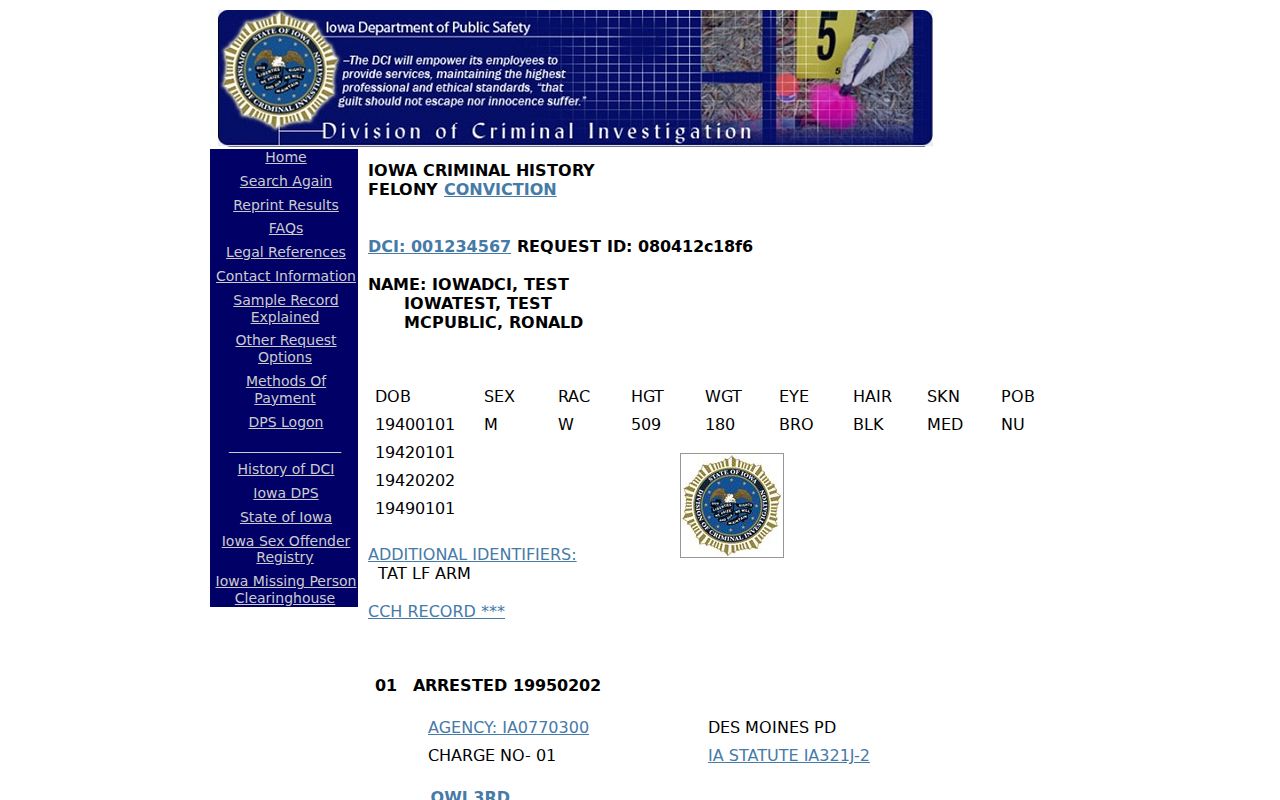
The sample shows why a DCI result must be read by arrest cycle and disposition, not reduced to a bare name match.
DCI states that “no record” can mean no Iowa history exists, existing information is not releasable without authorization, or confidential juvenile information exists. A missing fingerprint card can also prevent an Edgewood record from being created or updated. Most simple misdemeanors, other states, and federal convictions may fall outside the public Iowa product. Use the Edgewood source report and court docket to test the gaps.
Edgewood Federal Self-Review
An FBI Identity History Summary is a separate, subject-only option for reviewing your own fingerprint-linked federal identity history. It is broader than an Edgewood city report and different from Iowa Courts Online. Begin with the FBI Identity History Summary instructions, use the electronic request process, and submit fingerprints through an accepted channel.
The FBI electronic request portal supplied the image below.
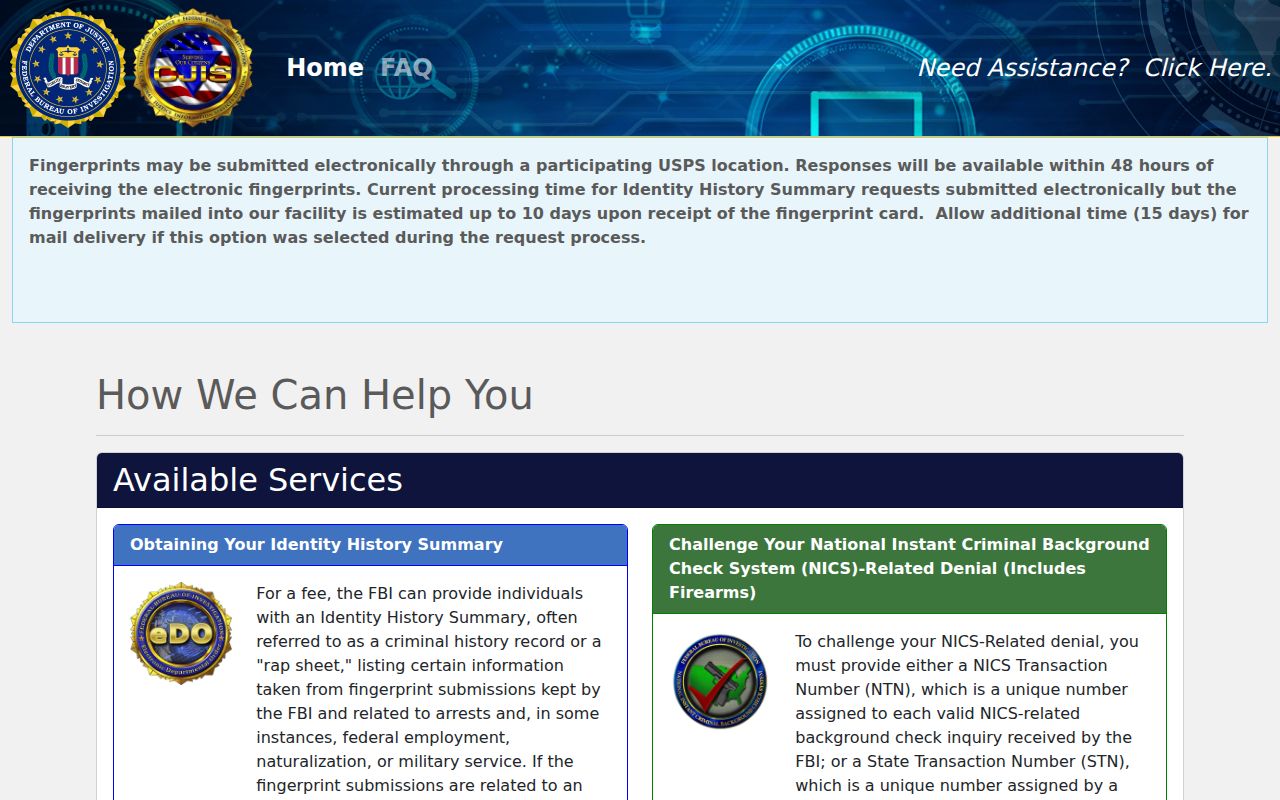
The federal process is useful for personal review, but it does not identify which Edgewood city or county office holds the original local narrative.
An FBI summary also should not be treated as a replacement for a two-county Edgewood search. It depends on fingerprint submissions reported to the FBI. The local court docket may contain events absent from the federal file, while the federal response may contain other jurisdictions. Federal court cases use the Northern District of Iowa and PACER rather than this subject-only FBI process.
Edgewood Record Access Rules
Iowa chapter 22 governs requests to Edgewood public offices, but it does not override records made confidential by another law. Request an identifiable existing record. Protected personal identifiers, victim-sensitive details, juvenile information, and confidential investigative material may be withheld or redacted. Possible warrant events follow Iowa Code chapter 808 and the issuing court’s access rules, while DCI release follows chapter 692.
Key Statutes:
Iowa Open Records Law, chapter 22 - grants inspection and copy rights while preserving confidential categories and lawful fees.
Iowa Code chapter 692 - controls DCI dissemination and gives a subject a route to access and challenge state history.
Iowa Court Rules chapter 16 - governs electronic access and protected information in an Edgewood court case.
Verify Edgewood results with the originating agency, jail, or clerk. The Edgewood boundary increases the chance that a one-county search is incomplete. A discharged deferred judgment follows the separate remedy in Iowa Code chapter 907, not a city-record correction. Record both county filters, the search date, and the Edgewood agency contacted.